

U.S. health care has become increasingly complex, leading to care delays and higher costs. An aging population with more health challenges, combined with persistent health care workforce shortages, is pushing demand beyond capacity. This results in delayed care, higher costs, and widening disparities in access and outcomes.1
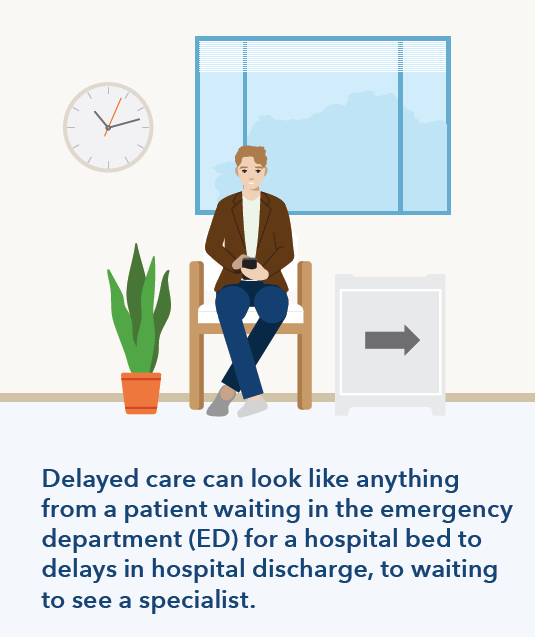 A comprehensive approach is needed. Efforts to streamline care have traditionally focused on individual departments, such as just the emergency department, rather than the full continuum of care. A narrowly scoped, department-specific strategy is insufficient to address the systemic challenges of a fragmented and complex health care system.
Care Without Delay delivers timely, coordinated, patient-centered care
Kaiser Permanente pioneered Care Without Delay (CWD) a comprehensive care management system to eliminate barriers across the health system and quickly get patients to the right care. It improves patient experience and care outcomes and is a core component to Kaiser Permanente’s approach to value-based care.
- Care Without Delay is a comprehensive system that reduces delays – it spans the emergency department, inpatient care, post‑acute transitions, ambulatory services, and home care. Dedicated teams continuously identify care delays, analyze patient flow, and escalate issues in real time, so issues are resolved quickly. Workflows and protocols are then refined based on frontline insights and patient experience.
- Care Without Delay teams use real-time data, dashboards, and standardized metrics to drive timely action. Teams monitor wait times, staffing needs, and operational performance. When metrics such as average length of hospital stays, readmission rates, or other avoidable delays miss quality targets, issues are escalated immediately to the appropriate clinical leaders for resolution.
- Care Without Delay is a multidisciplinary approach. Case managers, physicians, social workers, emergency department clinicians, and mental health specialists collaborate through team huddles, real-time bedside rounds, and shared decision-making. Addressing medical, social, and behavioral needs simultaneously reduces delays and improves patient experience.
A successful, replicable model
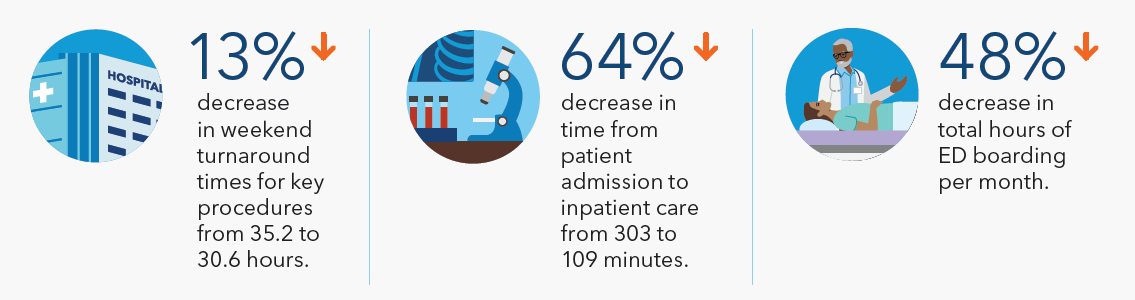
Across all Kaiser Permanente regions, Care Without Delay has reduced length of stay, emergency department wait times, and hospital readmissions – ensuring members receive the right care at the right time.2 The model is now being scaled by Risant Health, a nonprofit organization that brings together like-minded organizations to promote equitable, high-quality patient outcomes across the country. Geisinger, a Risant Health organization, is in the early stages of Care Without Delay implementation and is seeing successful results (see graphic below).3
Care Without Delay hospital performance metrics: *Results from Geisinger through September 2025. Launch dates: Intelligent triage – December 2024; Ambient clinical assistant – September 2024; Value-based care guides – September 2024; Care without delay – February 2025.
Through Risant Health, we are demonstrating that our approach to value-based care can be implemented in other health care systems throughout the nation, including in multi-payer, multi-provider environments, to deliver high quality, evidence-based, equitable, and affordable care. Care Without Delay is one important component helping us achieve these goals.