

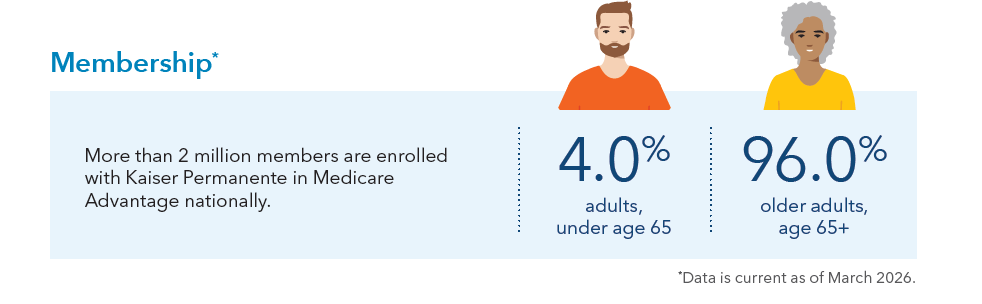
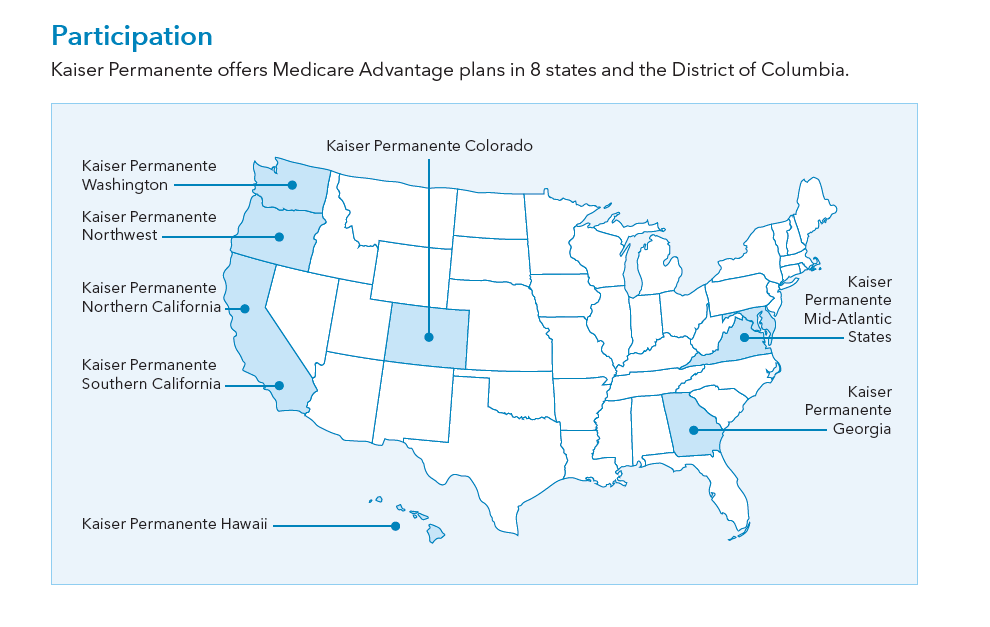
Our care in Medicare Advantage
Medicare is a federal health insurance program that provides health care coverage to millions of Americans who are 65 and older, and people with certain disabilities or health conditions may be eligible before they turn 65. It is designed to protect the health and financial security of those who use it. Medicare is comprised of four parts (A, B, C and D) covering specific services, from medical care to prescription drugs.
- Part A covers hospital and nursing home care, while Part B generally covers physician services. Together, Part A and Part B are called Traditional Medicare and are provided by the federal government. Traditional Medicare covers only about 80% of medical expenses and does not include prescription drug coverage. Beneficiaries must enroll in both Parts A and Part B be to eligible for Part C.
- Part C, known as Medicare Advantage, is another way to get Part A and Part B coverage. Medicare Advantage is offered by private health plans like Kaiser Permanente, and includes an annual out of- pocket cap, reduced cost sharing, and supplemental benefits not covered under Traditional Medicare.
- Part D is voluntary prescription drug coverage that can be combined with Traditional Medicare or included in Medicare Advantage plan design and is available from private health plans like Kaiser Permanente.
With our integrated care model, Kaiser Permanente achieves better outcomes through a combination of care coordination comprehensive data collection and use, and aligned incentives that all promote affordable, high-quality care. In most situations, Permanente Medical Groups provide the physician care, Kaiser Foundation Health Plan provides the coverage, and Kaiser Foundation Hospitals provide the medical facilities, as well as nursing and ancillary care. In our markets, we operate 40 hospitals and over 600 medical offices, employing over 25,000 physicians and over 76,000 nurses.

Dual Eligibility in Medicaid and Medicare**
Dual eligibles are those who are enrolled in both the Medicaid and Medicare programs Kaiser Permanente serves roughly 231,000 Medicare dual eligibles in total, with 126,000 enrolled in a Dual Eligible Special NeedsPlan (D-SNP) across California, Colorado, Georgia, and Hawaii. In recent years, Medicare Advantage plans have worked with statesto increase enrollment in integrated D-SNPs which better align coverage and care delivery
of Medicare and Medicaid benefits through a member-centered approach.
** Data current as of September 2025.
Quality in Medicare Advantage
Kaiser Permanente is highly rated on measures of quality across our markets, per the Centers for Medicare & Medicaid Services (CMS) 2026 Star Ratings. The Star Ratings announced in October 2025, which are applicable for the 2026 plan year, rated Kaiser Permanente Medicare Advantage plans either 4.0 or 4.5 out of 5 stars. These ratings are based on major categories that include preventive care, chronic care, prescription drug services, customer service, and member satisfaction.
All market program spotlight
Kaiser Permanente provides Medicare Advantage benefits that help improve access to care, affordability, and health outcomes for our members, especially those with the most complex needs. Key benefits provided in all markets include:
• Virtual care plays a pivotal role in providing convenient care to our members, including talking to a doctor or care team member by phone or video, scheduling appointments, viewing test results and health records, ordering prescriptions, and sending nonurgent health questions to a doctor’s office.
• Access to affordable prescription drugs is critical to supporting the health of many older adults. Our innovative approach to prescription drug coverage and purchasing for our members involves evidence-based medication selection, negotiated drug purchasing, and careful formulary design (the list of covered medications). Kaiser Permanente’s integrated model gives us the unique ability to leverage the pharmaceutical supply chain, manage our drug formulary, and design our pharmacy benefit to control drug costs, while ensuring we provide members with high-quality, safe prescription drugs. Through these efforts, we achieve upfront discounts when possible.
• Supplemental benefits refer to items and services that Medicare Advantage plans may offer beyond what is covered under Traditional Medicare. Each of our plans includes a unique set of benefits which vary by state. For example, benefits we offer include hearing, dental, vision, fitness, alternative medicine, and in-home support.